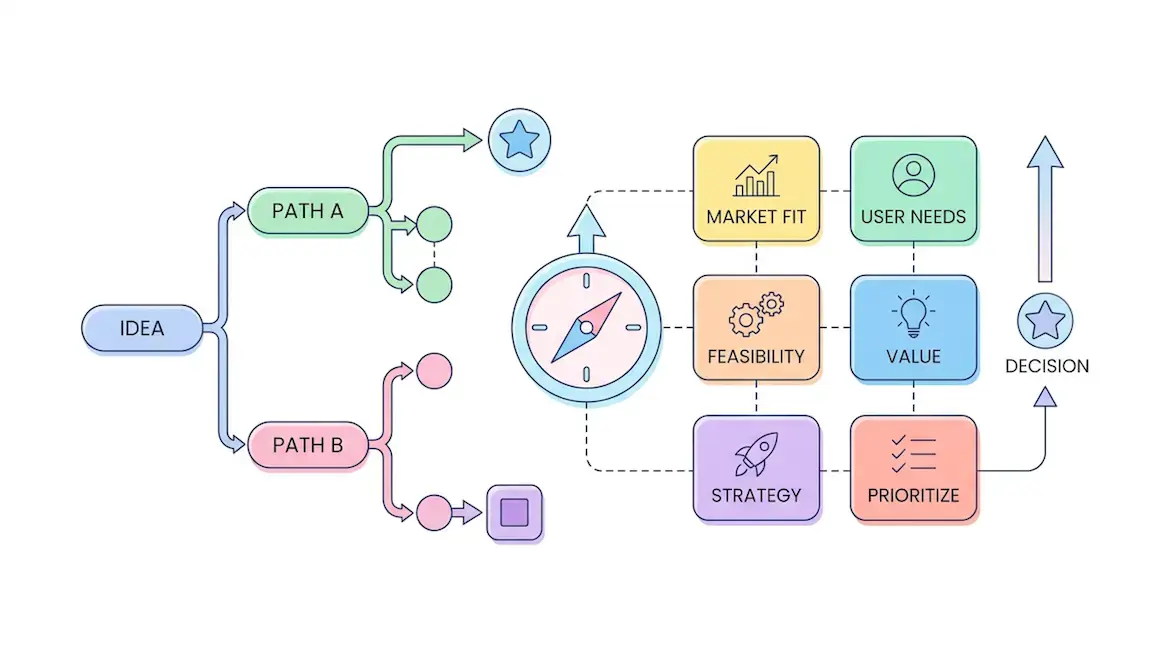
Making the right decisions is a major challenge in product management. Between identifying opportunities, prioritizing ideas, and validating hypotheses, the context quickly becomes complex. Product frameworks provide a structured solution to avoid improvisation and efficiently organize each step of the decision-making process. Thanks to these methodological tools, the entire team gains clarity on the stakes and accelerates its ability to choose where to focus efforts.
Why adopt a product framework in your decision-making process?
Regular use of a framework profoundly changes the structure of the decision-making process. You no longer settle for deciding under pressure: you analyze explicit selection criteria, prioritize, and communicate better. This organization saves time while strengthening the quality of collective trade-offs.
Without a defined framework, the temptation is strong to favor initiatives driven by intuition or the energy of the moment. Yet it is precisely when requests are abundant that you should rely on consistent decision-making steps. Adopting a framework thus provides constant and structured decision support regardless of the situations encountered.
What concrete benefits do product teams gain?
A framework reduces ambiguity when ranking tasks and makes it visible why one idea moves forward while another waits. This operating mode avoids many heated debates within the team communication, especially when everyone has their own perception of priority.
Sharing this method also leads to better impact assessment of each planned action. By clearly categorizing actions according to shared criteria, discussions become factual and facilitate collective buy-in around the next steps.
What are the main difficulties overcome with frameworks?
Working without a suitable tool multiplies hesitations, information overload, and friction points during trade-offs. Frameworks limit this decision-making fog by breaking down the thought process into logical sequences: identification, analysis, selection, follow-up. The risk of overlooking certain parameters decreases significantly.
Another sensitive point: hypothesis validation. It becomes much more efficient to test an intuition against a set of precise criteria before investing more resources, which limits wasted time on dead ends.
How do they foster clarity on the stakes?
When each project starts with a shared summary of objectives and constraints, clarity on the stakes is strengthened. Everyone knows which questions should guide the next iteration. This shared vision directly contributes to better distribution of responsibilities and encourages initiatives more aligned with the overall strategy.
This also reduces misunderstandings between technical, commercial, or design roles, as the reference framework becomes shared and transparent for everyone. Debates then shift toward rational analysis rather than remaining stuck on subjective arguments.
Which framework examples are most commonly used?
The choice of framework depends heavily on the current need: explore, prioritize, deliver, or learn. Here are some models frequently adopted for their effectiveness and simplicity of daily application.
Opportunity Solution Tree: ideal for quickly mapping out different development paths.
Prioritization matrix (RICE, MoSCoW): useful when you need to rank tasks based on objective criteria.
Value Stream Mapping: relevant for reviewing an entire process and detecting potential gains.
Hypothesis validation checklist: facilitates the transition from idea to rapid experimentation.
GUCCI Framework: structures the analysis of a product opportunity across five dimensions (mission, unmet needs, competition, segmentation, ecosystem) to produce defensible strategic recommendations.
Using multiple frameworks successively often strengthens decision support. For example, you start by mapping the problem, then refine the selection through a prioritization matrix before testing the robustness of the imagined solution.
What criteria to use when selecting your framework?
Several selection criteria come into play. The nature of the goal sought, whether discovery, sorting, evaluation, or implementation, remains central. It is also important to consider the team's level of maturity with these tools and its ability to adopt a sometimes new approach.
The flexibility of the format also plays a key role. Some frameworks lend themselves to occasional use while others become embedded in routine habits. Finally, the ease of team communication through this medium will ensure its real popularity.
How to sustainably establish framework usage in team rituals?
Gradually introducing frameworks into weekly meetings or specific workshops allows members to adopt them at their own pace. Over the course of discussions, everyone discovers the benefits of a reproducible structured decision-making process.
It is worthwhile to document these practices in a space accessible to all to reinforce the collective feeling and facilitate their dissemination. Quickly, this methodological foundation becomes a pillar on which the team can rely even during periods of high uncertainty.
How to maximize the effectiveness of product frameworks in your projects?
The effectiveness of a framework largely depends on the rigor with which it is applied. Having a theoretical scheme is not enough: it must be integrated daily into interactions and revisited regularly to adjust anything that could hinder its adoption.
The initial selection must always match the specific needs of the project, but regular follow-up is also necessary to ensure the continued usefulness of the method employed. Involving the entire team communication from the first step fosters alignment on decisions.
Five key principles for optimal decision support
Systematically involve stakeholders from the problem formulation stage.
Evolve selection criteria based on real field feedback rather than preconceptions.
Prioritize simplicity and operability of the chosen framework.
Encourage feedback sharing after each use to improve the approach.
Associate each framework with a tangible deliverable (roadmap, action plan, checklist).
Applying these principles ensures that impact assessment becomes less random and more reproducible, regardless of the complexity of the subject.
Integrating product frameworks as the backbone of your thinking ultimately installs a results-oriented culture, where idea prioritization, hypothesis validation, and pragmatic trade-offs take the place of gut feeling.