Optimizing team collaboration is an ongoing challenge for product leaders and technical teams. Faced with the proliferation of communication channels, fragmented processes, and rapidly evolving business needs, it becomes essential to adopt collaboration frameworks suited to your context. These structured approaches not only streamline project management but also strengthen transparency, engagement, and team efficiency across the board.
Why adopt frameworks to boost collaboration?
Using collaboration frameworks has become a lever to structure work organization and move beyond informal discussions. By making the rules of engagement explicit, each member can better understand their responsibilities, anticipate task interdependencies, and propose concrete improvements along the way.
With the rise of agile methodologies, many teamwork models have been developed to promote flexibility without sacrificing goal clarity. Far from being limited to one-off workshop use, these frameworks gradually integrate into strategic planning habits and into daily project tracking.
Key collaboration frameworks suited for product teams
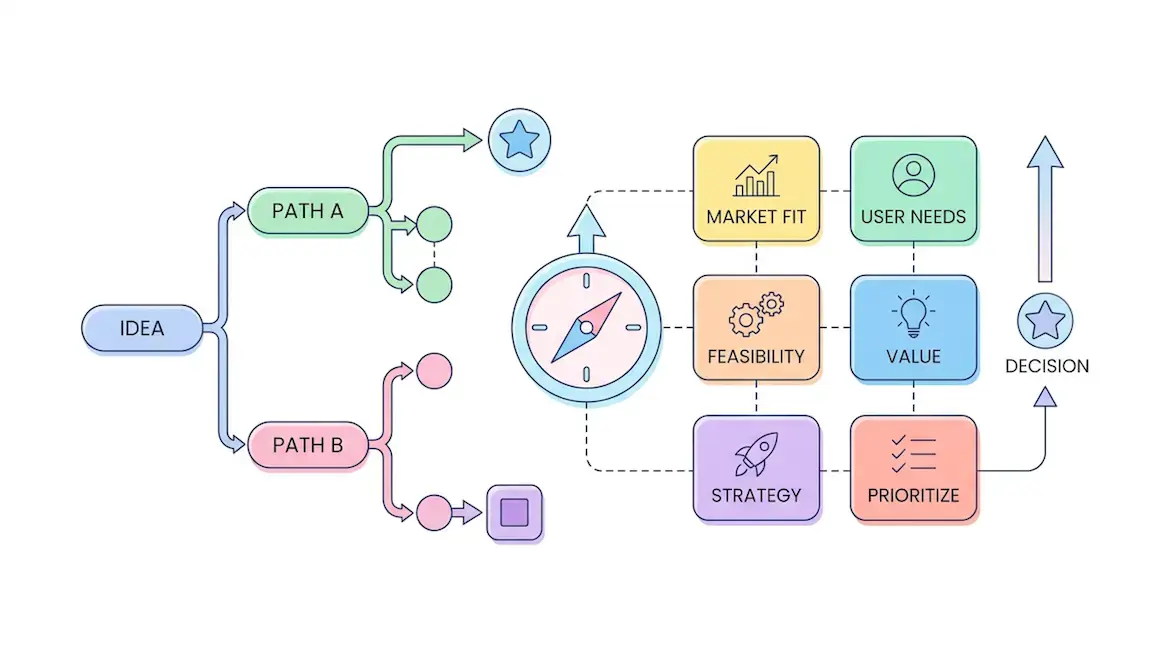
Identifying the most relevant framework starts with clarifying the primary need: managing prioritization, accelerating decision-making, facilitating team communication, or streamlining delivery. Several frameworks are particularly popular in the SaaS and tech space.
The choice also depends on the team's maturity level, the desired degree of autonomy, and the diversity of roles involved in cross-functional collaboration.
Kanban and Scrum: structuring and pacing execution
Kanban is effective for visualizing the flow of ongoing tasks and highlighting bottlenecks. Its approach encourages pragmatic project management while maintaining a balance between workload and delivered quality.
Scrum structures collaboration around short sprints, with rituals aimed at synchronizing the team and improving team efficiency. Well-defined roles (Product Owner, Scrum Master, team members) ensure that strategic planning and retrospectives remain key moments for collective alignment.
RACI and DACI: clarifying who does what and who decides
The RACI Matrix explicitly assigns four levels of responsibility: responsible, accountable, consulted, informed. It helps avoid ambiguity around task distribution and facilitates team communication, especially during critical launches or cross-functional projects.
DACI adds a decision-making dimension by emphasizing the 'driver' of a topic. During times of doubt or disagreement, this approach reduces friction and accelerates alignment on major decisions.
Integrating frameworks into rituals and team life
The value of frameworks does not lie solely in their documentation. Embedding them in daily life requires educational effort, as well as continuous readjustment based on context. To fully benefit from collaboration tools, these methods should be woven into existing routines without trying to revolutionize everything overnight.
Creating a shared space (digital or physical) where collaboration frameworks and associated procedures are accessible to everyone helps foster adoption and limit the risk of misunderstanding. A regular review of these models' relevance feeds the continuous improvement process.
Stand-ups and weekly syncs review
Collectively stating the day's objective, sharing blockers, or celebrating progress builds cohesion and prevents siloed work. Stand-ups draw heavily on agile methodology principles, combining speed and clarity.
A weekly meeting focused on 'problems/opportunities' allows for deeper reflection and opens the door to introducing new teamwork models as emerging needs arise.
Prioritization workshops and post-mortem sessions
Prioritization workshops often rely on matrices (such as MoSCoW or RICE), facilitating constructive debate on urgency and impact. This rigor makes strategic planning more transparent and strengthens fairness in effort distribution.
As for post-mortems, they provide a privileged moment to question process robustness and decide whether certain frameworks need to be simplified, refined, or replaced to support team efficiency.
Fostering cross-functional collaboration with tailored frameworks
In SaaS or cross-functional environments, bringing diverse profiles together around common objectives requires active listening and shared reference points. Adopting collaboration frameworks fosters a common language, regardless of professional backgrounds.
When developers, designers, sales teams, or customer support need to align on key initiatives, collaboration tools serve as the backbone for exchanges and limit the risk of misunderstandings from multiple viewpoints.
Jobs to be Done and Opportunity Solution Tree
The Jobs to be Done framework helps center the discussion on users' concrete challenges, independent of personal preferences. Breaking down expectations into actionable steps encourages seeking input from each expert, enriching the overall vision.
The Opportunity Solution Tree structures the identification of opportunities, then maps potential solutions. This visual work gives shape to cross-functional collaboration, involving multiple stakeholders from the start to find effective compromises.
Value Stream Mapping: mapping to eliminate pain points
Value Stream Mapping reveals how value flows between each department or team within the workflow. Highlighting latency times or clumsy handoffs between teams leads to co-designing adjustments that minimize wasted time.
This type of analysis puts the entire production cycle in perspective and increases the collective ability to fix what hinders efficiency, especially when a product passes through different areas of expertise before its final release.
Practical tips for choosing and customizing your collaboration frameworks
To achieve lasting results, framework selection should consider the volume of projects, the desired iteration pace, and team size. Introducing an overly complex model can generate rejection or counterproductive effects.
Slightly customizing each approach to truly fit the local context naturally improves collective motivation. It is better to start small and iterate than to apply too rigid a standard, especially in changing collaborative contexts.
Involve the team early in the framework selection
Test in real conditions on a limited scope before scaling
Collect feedback frequently and adjust along the way
Maintain accessible and clean documentation to ease onboarding
Invest in hands-on training rather than theory alone
Balancing individual autonomy and collective consultation is the key to benefiting from each framework. Training a few internal ambassadors facilitates gradual deployment and prevents fatigue or unnecessary complexity.
Experience also shows that good integration of collaboration frameworks into digital tools already in use optimizes adoption and ensures better longevity.